
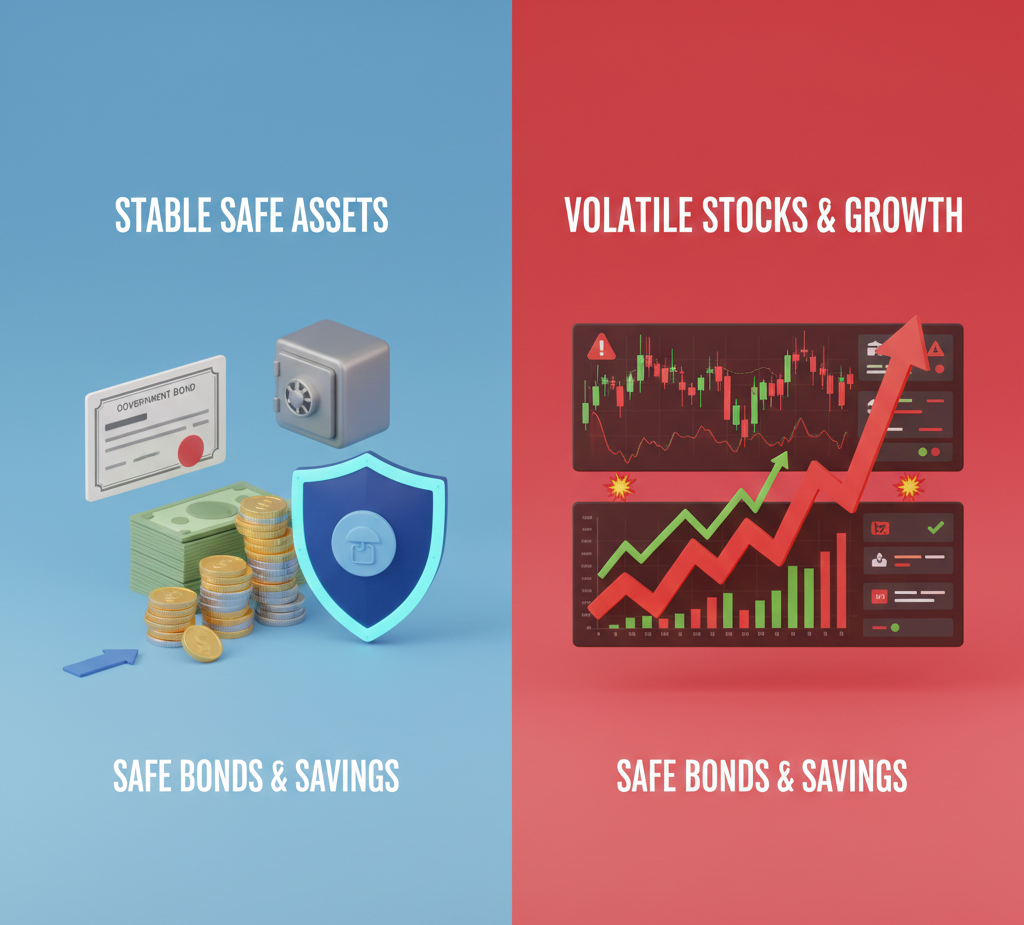
Safe vs Risky Investments — A Clear Beginner Guide to Understanding Investment Risk
One of the most important things every investor must understand is the difference between safe investments and risky investments. Many beginners either take too much risk without realizing it — or avoid all risk and miss growth opportunities. Both extremes can hurt long-term financial results.
Investing is not about choosing “safe only” or “risky only.” It is about understanding risk, matching it with your goals, and building a balanced strategy.
This guide explains what safe and risky investments are, how they differ, when to use each, and how beginners should decide between them.
What Does “Investment Risk” Mean?
Investment risk means the possibility that your actual return will be lower than expected — or that you could lose money.
Risk does not always mean loss — it means uncertainty.
There are two key parts:
- Return is not guaranteed
- Value can fluctuate
Higher uncertainty = higher risk
Higher risk = higher potential return (but also higher potential loss)
What Are Safe Investments?
Safe investments are assets where:
- Capital protection is high
- Return is more predictable
- Volatility is low
- Loss probability is low (not zero)
They focus more on stability than growth.
Common Features of Safe Investments
- Lower returns
- Lower price movement
- Income is often fixed
- Suitable for short-term needs
- Suitable for conservative investors
Examples of Safe Investments
✅ High-Quality Government Bonds
Loans to stable governments. Historically low default risk.
✅ Treasury Securities
Backed by government credit.
✅ Money Market Funds
Short-term, low-risk instruments.
✅ High-Yield Savings Accounts
Bank-based, highly liquid.
✅ Certificates of Deposit (CDs)
Fixed interest with time lock.
✅ Capital-Protected Funds (where available)
Structured to reduce downside risk.
Advantages of Safe Investments
✔ Capital Preservation
Lower chance of large losses.
✔ Predictable Returns
More stable income stream.
✔ Lower Stress
Less emotional volatility.
✔ Useful for Short-Term Goals
Good when money is needed soon.
Disadvantages of Safe Investments
❌ Lower Returns
Growth is limited.
❌ Inflation Risk
Returns may not beat inflation.
❌ Slower Wealth Building
Not ideal for long-term aggressive growth.
What Are Risky Investments?
Risky investments are assets where:
- Prices move significantly
- Returns are uncertain
- Losses are possible
- Growth potential is higher
They focus more on growth than stability.
Risky does not mean bad — it means volatile.
Examples of Risky Investments
⚠️ Stocks (Equities)
Company ownership — prices fluctuate daily.
⚠️ Growth Stock Funds
Focused on fast-growing companies.
⚠️ Sector Funds
Invest in one industry only.
⚠️ Small-Cap Stocks
Smaller companies with higher volatility.
⚠️ Cryptocurrencies
Extremely volatile digital assets.
⚠️ Leveraged ETFs
Amplified market movement products.
⚠️ Startup / Angel Investing
Very high risk, high uncertainty.
Advantages of Risky Investments
✔ Higher Growth Potential
Historically outperform safe assets long term.
✔ Inflation Beating
Better chance to exceed inflation.
✔ Wealth Creation Engine
Essential for long-term portfolio growth.
Disadvantages of Risky Investments
❌ Price Volatility
Values can drop sharply.
❌ Emotional Stress
Market swings cause panic.
❌ Timing Risk
Short-term losses possible.
❌ Knowledge Requirement
Needs understanding and discipline.
Risk vs Return Relationship
This is the core investing rule:
Higher expected return requires accepting higher risk.
If an investment promises high return with no risk — it is likely misleading or a scam.
There is no high-return, zero-risk investment in real markets.
Time Horizon Changes Risk
Time reduces risk impact for growth assets.
Short Time Horizon
Risky investments are dangerous.
Long Time Horizon
Risky investments become more manageable because markets historically trend upward over long periods.
Example:
Stocks are risky for 1 year — less risky over 15 years.
Matching Investment Type to Goal
Use Safe Investments For:
- Emergency funds
- Short-term goals
- Money needed within 3 years
- Capital protection priority
- Conservative investors
Use Risky Investments For:
- Retirement investing
- Long-term wealth
- Goals 7+ years away
- Growth priority
- Younger investors
Age-Based Risk Approach (General Rule)
While personal factors matter, a common framework:
Younger Investors
Can take more risk — more time to recover.
Mid-Age Investors
Balanced risk — mix of growth and safety.
Near Retirement
Lower risk — protect capital.
Time remaining matters more than age alone.
Portfolio Balance — The Smart Approach
Smart investors do not choose only safe or only risky.
They combine both.
Example Balanced Portfolio
- 60% growth assets (stocks, index funds)
- 30% stability assets (bonds)
- 10% defensive assets (gold/cash)
Balance reduces extreme outcomes.
Risk Capacity vs Risk Tolerance
These are different.
Risk Capacity
Your financial ability to take risk.
Risk Tolerance
Your emotional comfort with risk.
You must satisfy both.
Example:
High capacity but low tolerance → still choose moderate risk.
How Beginners Should Choose Risk Level
Ask:
- When do I need this money?
- Can I handle a 20% drop calmly?
- Do I have stable income?
- Do I have emergency savings?
If unsure → start moderate.
You can increase risk later with experience.
Common Beginner Risk Mistakes
❌ Taking Too Much Risk Too Early
Leads to panic exits.
❌ Taking No Risk at All
Leads to inflation loss.
❌ Copying Others’ Risk Levels
Your finances are unique.
❌ Confusing Volatility With Danger
Price movement ≠ permanent loss unless sold.
Practical Beginner Allocation Example
Moderate Beginner Portfolio
- 50–60% index funds
- 20–30% bonds
- 10% defensive assets
- Optional small exploration allocation
Simple. Balanced. Scalable.
Final Summary — Safe vs Risky Investments
Safe investments offer:
- Stability
- Lower returns
- Capital protection
Risky investments offer:
- Higher growth
- Higher volatility
- Wealth-building potential
Smart investing is not choosing one — it is balancing both based on goals, timeline, and tolerance.
Best beginner rule:
Protect short-term money.
Grow long-term money.